AEON Point Installs a Mini-Museum in the HQ of a Fortune 100 Company
AEON Point
By Akash Bartlett01.10.2603 MIN
AEON just wrapped a mini-museum installation for a Fortune 100 company at their HQ - a permanent exhibit walking visitors through their history, manufacturing scale, and the impact their products have on people's daily lives. Unlike a live event, the system needed to operate independently with a single point of control. Here’s how we made it work:
The Network Backend and Control System
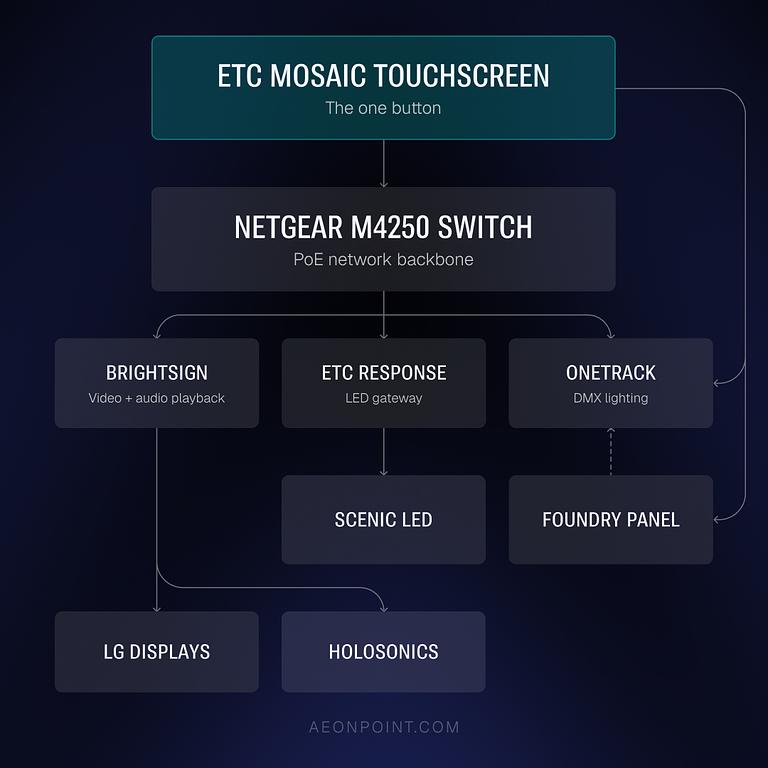
The desired end result was a single button to turn the whole room on and off. But, as some of you may know, it can be a challenge to control a collection of equipment from different manufacturers. And the priority was ease-of-use and reliability, so all of this had to all be transparent to the end user who were not show staff but building staff and employees.
The ‘button’ is actually a Mosaic Touchscreen from Electronic Theater Controls (ETC). In addition to natively driving DMX to control the lighting in the room (more on that later), the Mosaic show controller makes sending UDP triggers on events, scenes, and timelines extremely reliable and easy to program.
The connectivity backbone of the system was a Netgear M4250 PoE switch which, thanks to its Layer 3 capabilities, was able to handle a few VLANS and DHCP for the system. A large PoE budget was also a must because power supplies and outlets were not easy to fit into the tight scenic elements. I’ve been using Netgear switches for years. They’re rock solid and easy to handoff to building IT when the time comes.
The AV Components: Screens and Speakers
We had ~7 video surfaces around the room, ranging from familiar 55" panels up to massive 90" displays built into scenic facades. Longevity and energy use were both a factor - these displays needed to power off completely when the room shut down for the night, then reliably wake from true power-off, launch content, and loop it until triggered off again. That ruled out consumer TVs pretty quickly.
For all those reasons, I went with a line from LG Digital Signage. On the surface they look like regular TVs, but the panels and software underneath are more feature-rich and built for exactly this kind of control - scheduled wake, remote monitoring, actually reliable HDMI CEC. My favorite feature? Being able to copy settings on a flash drive from one panel to another, so I didn’t have to stand in front of each one with a remote going through a billion menus.
Content and video control run through purpose-built XD media players from BrightSign. These are really compact, PoE devices that network easily with other units and can be centrally configured, controlled and programmed through their free software. It was my first time with Brightsign, and I was happy with how fast I was able to get the content all loaded and programmed to listen for the UDP triggers from Mosaic.
The audio was a really fun part. We went with directional audio from HoloSonics - the same "audio spotlight" tech you'd find in a high-end museum. Stand in the right spot and you're in a small, isolated cone of sound; step out of it and you can barely hear a faint whisper. It’s pretty cool in person and works exactly as you’d imagine.
The Lighting System
The room itself is sculpted by a museum-grade OneTrack system from ETC - the same architectural fixtures doing the job a museum expects, with clean dimming, shutters, and zoom for precision. The track system made it easy for contractors to install the infrastructure and allowed us to move fixtures around at will during focus, which is a huge flexibility upgrade compared to permanently mounted units.
The scenery in the room was also packed with LED lighting and other electrical elements built into the facades. All individually controllable and tunable but not all from the same manufacturer. For control and distribution here, we did regular DMX over Cat6 for ease of installation.
That's where ETC's Response PoE gateways come in - they get all those LEDs onto the same network as everything else, allowing us to control them from the central Mosaic controller. Instead of having to set each scenic element on its own, it's all just standard sACN and DMX.
And at night, when everything is off, a Foundry relay panel shuts off the power to the track lights, saving hours of runtime on the onboard electronics, and extending the life of the fixtures as long as possible. All while maintaining proper egress lighting levels if needed, with power loss sensing and emergency failovers thanks to a few other specialized controllers from ETC.
The Result
So finally, the end result: the room turns itself on and off on a schedule. It's on when it needs to be, off when nobody's around. And when someone needs to override it, it's one button on that Mosaic touchscreen, and the whole room lights up - lights, video, and audio.